
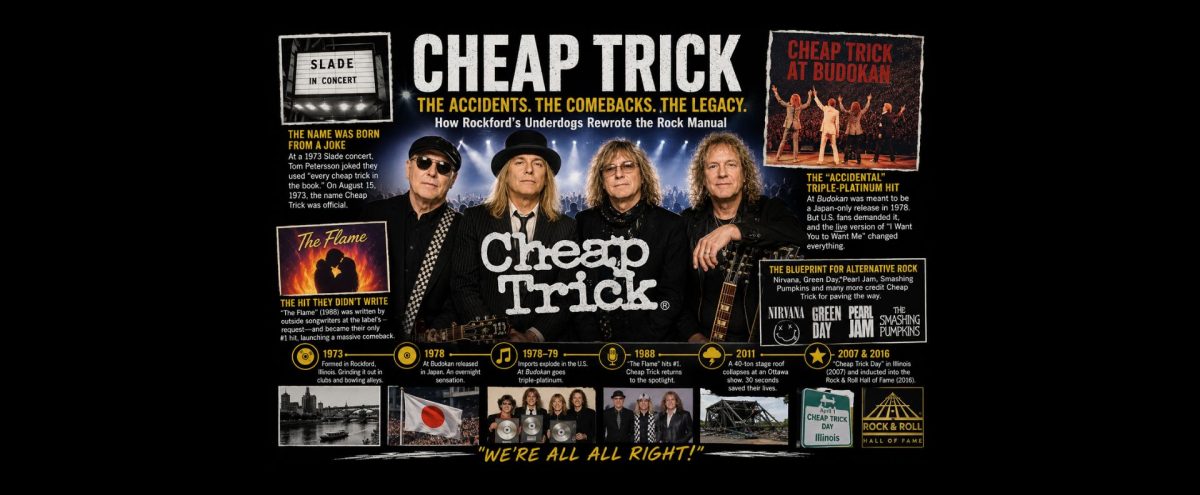
For more than five decades, Cheap Trick has occupied a unique place in rock history. They were never the biggest band in America. They were rarely the critics’ favorite. Yet somehow, they survived changing musical trends, record label battles, near-death experiences, and the rise and fall of countless competitors.
From their humble beginnings in Rockford, Illinois, to their induction into the Rock and Roll Hall of Fame, Cheap Trick built a career unlike any other. Their story is filled with unexpected twists, accidental breakthroughs, and moments that could have ended everything.
Here are the remarkable secrets behind one of rock’s most enduring bands.
The Underdogs Who Refused to Quit
Cheap Trick formed in Rockford, Illinois, in 1973. At the time, Rockford was hardly considered a launching pad for rock superstardom. The city sat far from the music industry power centers of Los Angeles and New York.
Instead of relying on industry connections, the band developed its reputation the old-fashioned way. They played relentlessly.
Warehouses, bowling alleys, clubs, bars, and theaters became their training grounds. Night after night, they refined a sound that seemed impossible on paper.
Cheap Trick blended three distinct musical influences:
- The melodic songwriting of the British Invasion
- The loud guitars of hard rock
- The raw energy of punk
That combination created something entirely new. While many bands chose one lane, Cheap Trick traveled several at once.
The formula would eventually inspire generations of musicians, but in the beginning, it simply made them difficult to categorize.
The Name Came From an Offhand Remark
Some bands spend months searching for the perfect name.
Cheap Trick found theirs almost by accident.
While attending a 1973 concert by the British glam-rock band Slade, bassist Tom Petersson observed the group’s stage antics and commented that they were using “every cheap trick in the book” to entertain the audience.
The phrase stuck.
On August 15, 1973, the band officially adopted the name Cheap Trick.
Ironically, a name that sounded almost disposable became one of the most recognizable brands in rock music. What started as a sarcastic observation eventually appeared on millions of records sold around the world.
The name also perfectly reflected the band’s personality—humorous, self-aware, and never overly concerned with rock-star pretension.
Japan Saw Their Greatness Before America Did
One of the most fascinating chapters in Cheap Trick’s story happened thousands of miles away from home.
While their first studio albums earned critical praise in the United States, mainstream commercial success remained elusive.
Japan, however, saw something different.
Japanese audiences embraced Cheap Trick with extraordinary enthusiasm. The band’s blend of Beatles-inspired melodies and explosive live performances resonated deeply with fans.
By 1978, they had become one of the hottest foreign acts in the country.
The scenes were astonishing.
Fans screamed, cried, and packed venues with a level of excitement rarely seen outside Beatlemania.
The band had become superstars overseas while remaining largely underappreciated in their own country.
That unusual situation would soon change everything.
The Live Album That Was Never Supposed to Be a Hit
Few albums have altered a band’s destiny the way At Budokan changed Cheap Trick’s.
Originally, Epic Records intended the live album as a Japan-only release. It was meant to be a souvenir for Japanese fans rather than a major commercial project.
Nobody expected what happened next.
American fans began importing copies of the record in huge numbers. Radio stations started playing tracks from the album, especially the electrifying live version of “I Want You to Want Me.”
Demand exploded.
The label had no choice but to release the album in the United States.
The result was one of rock’s greatest accidental success stories.
At Budokan became a triple-platinum phenomenon and transformed Cheap Trick from cult favorites into international stars.
Suddenly, the band that had struggled to break through in America was headlining arenas and dominating radio.
Why Their Early Mindset Made Success Possible
One reason Cheap Trick survived long enough to experience their breakthrough was their attitude toward success.
Unlike many artists obsessed with chart positions and sales figures, the band focused on creating music and moving forward.
Rick Nielsen later explained that they cared more about making records than monitoring numbers.
If a radio station in Chicago played one of their songs, that was exciting enough.
Instead of worrying about commercial performance, they simply kept writing and recording.
That approach allowed Cheap Trick to stay productive during the years when success seemed uncertain.
When their breakthrough finally arrived, they were ready because they had already built a deep catalog and a powerful live reputation.
The Hit Song They Didn’t Want
The 1980s brought a new challenge.
After years of success, Cheap Trick experienced a commercial decline. Radio tastes changed, and record labels became increasingly aggressive about demanding hits.
Epic Records believed the band needed outside songwriters.
The resulting album, Lap of Luxury, became a source of tension.
For a band that had built its identity on original material, collaborating with professional songwriters felt like a compromise.
Yet the biggest irony was still ahead.
“The Flame,” a power ballad written by outside writers, became Cheap Trick’s only No. 1 single.
The song topped the charts in 1988 and introduced the band to a new generation of listeners.
Even more remarkably, the success sparked a major comeback. Their cover of Elvis Presley’s “Don’t Be Cruel” soon followed, reaching the Top 10.
The very song that represented artistic compromise also revived their career.
Cheap Trick Helped Create Alternative Rock
Many fans associate Cheap Trick with classic rock radio.
However, their influence extends far beyond their own era.
By combining melodic hooks with aggressive guitars, they created a blueprint that countless alternative bands would follow.
Their formula connected three major musical traditions:
1960s Guitar Pop
The Beatles, The Who, and The Kinks provided the foundation for Cheap Trick’s songwriting style.
Strong melodies remained at the center of every song.
1970s Hard Rock
Heavy riffs and loud amplifiers gave the band its power.
Their concerts delivered the intensity expected from arena rock.
Punk Energy
Cheap Trick embraced speed, attitude, and urgency at a time when many established rock acts were becoming increasingly polished.
The result became a roadmap for future musicians.
Bands including Nirvana, Green Day, Pearl Jam, and the Smashing Pumpkins have all acknowledged Cheap Trick’s influence.
Without Cheap Trick, the sound of 1990s alternative rock might have developed very differently.
The Night Disaster Nearly Struck
After decades on the road, Cheap Trick earned a reputation as one of rock’s hardest-working bands.
Then came one of the most frightening moments in their history.
In July 2011, the band was performing at Ottawa Bluesfest when severe weather approached.
A violent thunderstorm moved toward the festival grounds.
Only twenty minutes into their set, the situation became critical.
The massive 40-ton stage roof began to fail.
Band members and crew members had roughly 30 seconds to react.
Everyone scrambled for safety as the enormous structure collapsed.
The outcome could have been catastrophic.
Instead, a remarkable stroke of luck helped save lives.
The band’s tour truck was positioned behind the stage and acted as a brace. It absorbed part of the collapse and slowed the falling structure just enough to create an escape window.
The incident remains one of the closest calls in the band’s long career.
Rockford Never Forgot Its Hometown Heroes
Despite achieving worldwide success, Cheap Trick has always maintained strong ties to Rockford and the state of Illinois.
That loyalty has been returned many times over.
In 2007, the Illinois Senate officially declared April 1 as “Cheap Trick Day.”
Few rock bands can claim an official statewide holiday.
Rockford went even further.
The city incorporated artwork from Cheap Trick’s Rockford album into official vehicle stickers.
It was a unique tribute that transformed the band’s legacy into a visible part of daily life.
Residents literally drove around town displaying symbols connected to the hometown group.
For a band that started in local clubs and bowling alleys, it represented a full-circle moment.
The Rock Hall Recognition Was Long Overdue
In 2016, Cheap Trick finally received one of rock’s highest honors.
The band was inducted into the Rock and Roll Hall of Fame.
For many fans, the recognition was overdue.
By that point, the numbers alone were impressive:
- More than 20 million albums sold
- Over 5,000 live performances
- Decades of influence across multiple genres
- A catalog spanning generations
Yet the induction recognized more than statistics.
It acknowledged a band that had consistently balanced artistry, humor, musicianship, and resilience.
Still Rocking Into the 2020s
Many classic rock bands spend their later years relying exclusively on nostalgia.
Cheap Trick has chosen a different path.
The group continues to release new music and tour extensively.
Albums such as In Another World demonstrated that the creative spark remains intact decades after their formation.
Even as musical trends evolve, Cheap Trick continues to attract new listeners while maintaining one of rock’s most loyal fan bases.
Their longevity speaks to the timeless appeal of great songs, powerful performances, and a willingness to keep moving forward.
Conclusion: The Blueprint That Changed Rock
Cheap Trick’s story is filled with contradictions.
They were American stars who first became famous in Japan.
Their biggest album was never intended to be a major release.
Their only No. 1 hit was written by someone else.
They survived industry pressures, changing trends, and even a collapsing stage roof.
Yet through every twist and turn, the band remained true to the qualities that made them special from the beginning: unforgettable melodies, relentless work ethic, and a refusal to quit.
Today, Cheap Trick stands as one of rock’s most influential survivors. Their fusion of power pop, hard rock, and punk energy helped shape modern alternative music and inspired countless artists who followed.
More than fifty years after four musicians from Rockford decided to take a chance on a “cheap trick,” their legacy remains anything but cheap. It remains one of the most important success stories in rock and roll history.