
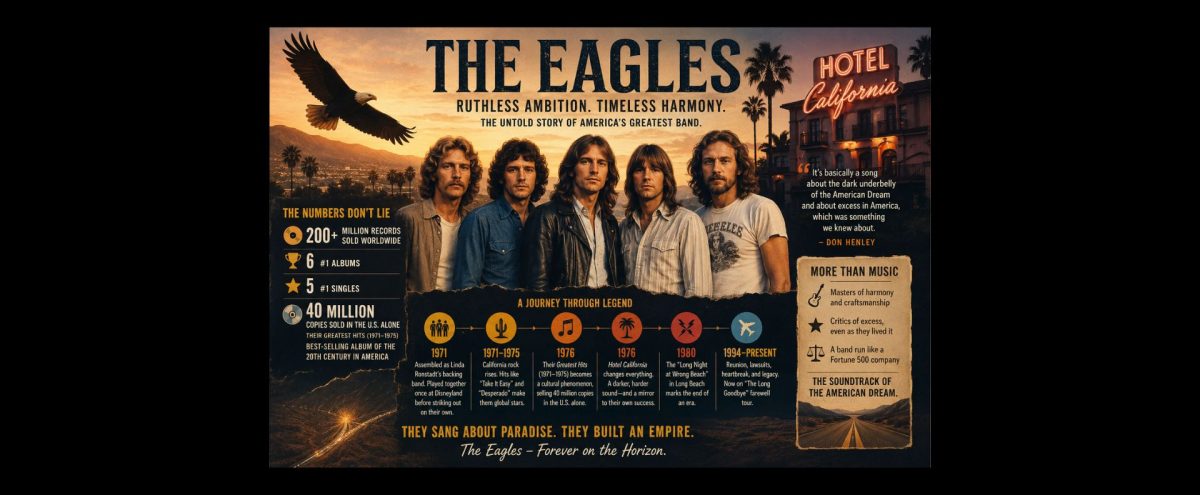
The Eagles are often remembered as the soundtrack of endless highways, desert sunsets, and the carefree spirit of 1970s California. Songs like “Take It Easy,” “Peaceful Easy Feeling,” and “Already Gone” painted a picture of freedom and optimism that became deeply woven into American culture.
Yet behind those flawless harmonies was a band driven by intense ambition, relentless perfectionism, and internal conflict. Their story is not merely one of musical success. It is the story of how a group of talented musicians transformed themselves into the most commercially successful American band of all time.
With more than 200 million records sold worldwide, six number-one albums, five number-one singles, and one of the best-selling albums in history, the Eagles built a musical empire. But their rise came at a price.
From Sidemen to Superstars
Unlike many legendary bands, the Eagles did not begin as a group of friends playing local clubs.
Their origins were remarkably professional.
In 1971, Glenn Frey, Don Henley, Bernie Leadon, and Randy Meisner were recruited to serve as the backing band for singer Linda Ronstadt. Each member already possessed significant experience in the music industry.
Bernie Leadon had earned respect through his work with the Flying Burrito Brothers. Randy Meisner had played with Rick Nelson’s Stone Canyon Band and briefly helped found Poco. Don Henley and Glenn Frey were emerging talents searching for the right opportunity.
The four musicians performed together as Ronstadt’s complete backing band only once, at a concert in Disneyland. That single performance would change rock history.
Recognizing the chemistry between them, the musicians decided to form their own group. Through connections within the Laurel Canyon music scene, Glenn Frey was introduced to music executive David Geffen by songwriter Jackson Browne.
Geffen immediately saw potential and signed the new band to Asylum Records.
The Eagles were then encouraged to retreat to Aspen, Colorado, where they could develop their sound and identity. What emerged was a band uniquely positioned to dominate mainstream radio.
They were not accidental stars. They were experienced professionals who understood exactly how to craft songs that connected with millions.
A Name Forged in the Desert
The band’s name emerged during a memorable desert excursion involving peyote, tequila, and a search for inspiration.
But even the story behind the name reveals an important truth about the Eagles.
Bernie Leadon viewed the eagle through a spiritual lens, inspired by Native American symbolism and the mystical atmosphere of the Mojave Desert.
Glenn Frey’s version was considerably simpler.
According to Frey, he saw eagles flying overhead and enthusiastically shouted, “Eagles!”
The contrast is revealing.
Leadon represented the band’s artistic and country-rock roots. Frey represented focus, direction, and commercial instinct.
That same instinct later influenced a surprisingly important branding decision. When comedian Steve Martin suggested they call themselves “The Eagles,” Frey rejected the idea. The group would simply be “Eagles.”
It may seem like a minor detail, but it reflected Frey’s commitment to creating a clear and memorable identity.
From the beginning, Eagles was more than a band. It was a brand.
The Rise of California Rock
The Eagles arrived at precisely the right moment.
America was moving away from the psychedelic experimentation of the late 1960s. Audiences wanted songs that felt personal, relatable, and melodic.
The Eagles delivered exactly that.
Their early albums blended country influences with rock arrangements, creating a sound that became known as California Rock.
Hits such as “Take It Easy,” “Witchy Woman,” “Desperado,” and “Best of My Love” established the band’s reputation as masters of songwriting and harmony.
What separated the Eagles from many of their contemporaries was their commitment to accessibility.
Their songs were sophisticated without being complicated.
Their lyrics felt personal while remaining universal.
Most importantly, their music sounded incredible on FM radio.
At a time when radio was the dominant force in music consumption, the Eagles became one of its greatest beneficiaries.
The Greatest Hits Phenomenon
In 1976, the Eagles released a compilation album that would rewrite music history.
Their Greatest Hits (1971–1975) was originally intended to celebrate the band’s success and prepare audiences for their next chapter.
Instead, it became a cultural phenomenon.
The album sold approximately 40 million copies in the United States alone and eventually became one of the best-selling albums ever released.
Its impact extended beyond impressive sales numbers.
The collection transformed the Eagles into a permanent fixture of American life.
For millions of listeners, this album became the definitive soundtrack for road trips, backyard gatherings, and everyday life.
Most legendary artists are defined by a single masterpiece album.
The Eagles were different.
Their greatest-hits package became every bit as important as their studio recordings.
By the mid-1970s, they had successfully sold not just songs but an entire vision of the American Dream.
Hotel California Changes Everything
If the early Eagles represented optimism, Hotel California represented disillusionment.
Released in late 1976, the album marked a dramatic evolution.
The addition of guitarist Joe Walsh and the increasing influence of Don Felder pushed the band toward a harder and more aggressive sound.
The result was one of rock music’s greatest achievements.
The title track became an instant classic.
Its mysterious lyrics generated endless speculation. Some listeners believed the song contained references to Satanism. Others viewed it as a commentary on Hollywood excess.
Don Henley eventually clarified the song’s true meaning.
It was about the dark side of success.
It was about excess, greed, and the emptiness that can accompany wealth and fame.
In many ways, it was also autobiographical.
The Eagles had become enormously successful, but that success was creating tensions within the band.
The paradise they celebrated in song was beginning to feel like a prison.
Perfection at Any Cost
The creation of Hotel California demonstrated both the band’s brilliance and its dysfunction.
The Eagles became famous for their obsessive attention to detail.
Every vocal harmony, guitar part, and arrangement was scrutinized relentlessly.
The pursuit of perfection produced extraordinary music.
It also produced resentment.
One famous example involved the song “Victim of Love.”
Don Felder reportedly believed he would sing the lead vocal. Instead, while Felder was away, Don Henley recorded the lead himself.
The final result was excellent.
The process, however, damaged relationships within the band.
Stories like this became increasingly common.
As the Eagles grew more successful, personal trust began to erode.
The band’s greatest strength—its relentless pursuit of excellence—was slowly becoming its greatest weakness.
The Breaking Point
Internal tensions had existed for years.
Bernie Leadon had already left the group after famously pouring a beer over Glenn Frey’s head during an argument.
Joe Walsh and Timothy B. Schmit joined the lineup and helped sustain the band’s success, but the underlying problems remained.
Everything finally exploded on July 31, 1980.
The concert took place in Long Beach, California.
Later remembered as the “Long Night at Wrong Beach,” the performance became legendary for all the wrong reasons.
During the show, Glenn Frey and Don Felder exchanged threats while continuing to perform.
According to later accounts, they counted down the remaining songs and discussed fighting each other once the concert ended.
The audience had no idea.
The band sounded professional and polished.
Behind the scenes, however, the Eagles were falling apart.
Soon afterward, they stopped functioning as a group.
The Fourteen-Year Vacation
The Eagles did not officially announce a dramatic breakup.
Instead, they simply disappeared.
For fourteen years, the members pursued solo careers and avoided working together.
Fans assumed the band was finished forever.
Then, in 1994, the impossible happened.
The Eagles reunited for the Hell Freezes Over tour.
The tour’s title referenced an earlier comment suggesting the band would reunite only when hell froze over.
Glenn Frey, always skilled at managing public perception, offered a memorable explanation.
“For the record, we never broke up. We just took a 14-year vacation.”
The reunion became one of the most successful comeback stories in music history.
Audiences who had grown up with the Eagles eagerly filled arenas across North America.
The band’s legacy was stronger than ever.
Lawsuits, Legacy, and Loss
Despite the reunion, internal conflict never completely disappeared.
In 2001, guitarist Don Felder was dismissed from the band.
The split triggered a lengthy legal battle involving profit-sharing and business arrangements.
The lawsuit highlighted an uncomfortable reality.
The Eagles had always been both a band and a corporation.
Their success required structure, management, and financial discipline.
Unfortunately, those same elements often intensified personal disagreements.
Then came a far more significant loss.
In 2016, Glenn Frey passed away at age 67.
For many fans, it seemed impossible to imagine Eagles continuing without one of its founders.
Yet the band found a way forward.
Glenn’s son, Deacon Frey, joined the lineup alongside country music star Vince Gill.
Together, they helped preserve the music while honoring Frey’s legacy.
The Long Goodbye
Today, the Eagles are completing what they describe as “The Long Goodbye.”
Their farewell performances, including appearances at the spectacular Las Vegas Sphere, represent the closing chapter of one of the most remarkable stories in rock history.
Their influence remains enormous.
Countless artists continue to borrow from the Eagles’ blend of melody, harmony, and craftsmanship.
Their songs remain staples of classic-rock radio.
Their albums continue to sell.
Their music continues to connect generations.
Yet perhaps the most fascinating aspect of their story is what it reveals about America itself.
The Eagles embodied both the promise and the contradictions of the American Dream.
They celebrated freedom while operating with corporate discipline.
They sang about peace while battling one another behind the scenes.
They critiqued excess even as they benefited from it.
In the end, those contradictions helped make them unforgettable.
Conclusion
The Eagles were never simply a band.
They were a phenomenon.
Their music captured the optimism, ambition, excess, and complexity of modern America better than almost any artist of their era.
From a one-time backing band for Linda Ronstadt to the best-selling American band in history, their journey remains one of the most extraordinary success stories in popular music.
Their harmonies sounded effortless.
Their success was anything but.
Behind every peaceful easy feeling stood relentless ambition, meticulous craftsmanship, and a determination to be the very best.
That combination transformed the Eagles from talented musicians into legends whose music still defines the American soundtrack decades later.