
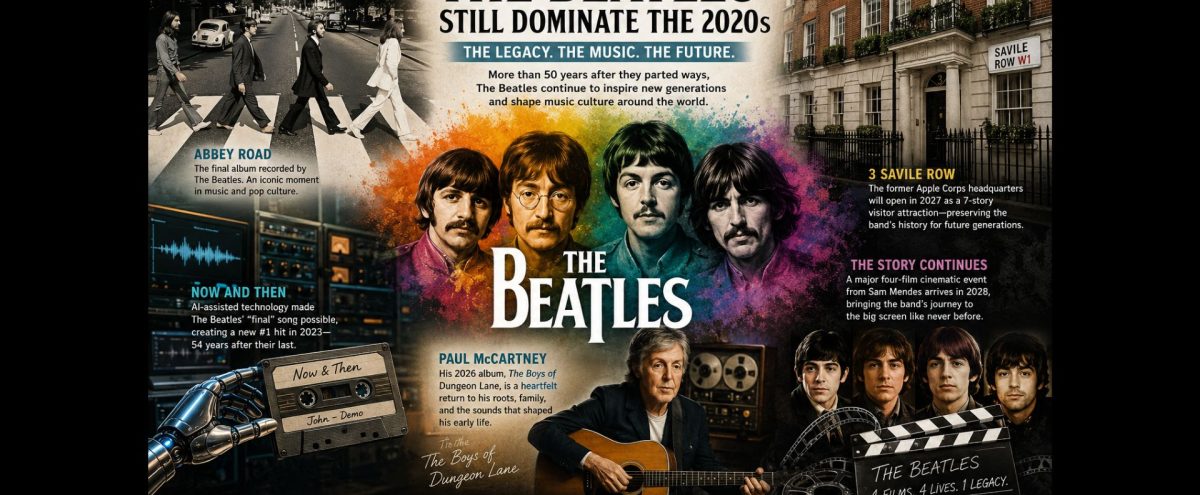
More than five decades after their breakup, The Beatles remain one of the most powerful forces in global entertainment. Few artists from any era continue to influence culture, technology, fashion, film, and music the way John Lennon, Paul McCartney, George Harrison, and Ringo Starr do today.
The year is 2026, and The Beatles are not simply remembered—they are actively shaping conversations around music and creativity. Their songs continue to stream by the millions, new projects keep emerging, and younger generations are discovering their catalog through digital platforms.
What makes this remarkable is that the band officially stopped working together in 1970. Yet their impact feels as current as ever.
From AI-assisted recordings and immersive museums to new McCartney projects and major Hollywood films, The Beatles continue to prove that their story is far from over.
The Beatles Are More Relevant Than Ever
Most legendary artists eventually settle into the role of historical figures. Their music is respected, but their cultural influence fades.
The Beatles have followed a completely different path.
Instead of becoming a nostalgic memory, they have evolved into a living brand of creativity. Every year seems to bring another major Beatles-related event, whether it is a documentary, a remastered album, a newly discovered recording, or a fresh exploration of their legacy.
This continued relevance comes from the timeless nature of their music. Songs like “Hey Jude,” “Let It Be,” “Come Together,” and “Something” continue to connect with audiences because they address universal human experiences.
Love, hope, friendship, loss, ambition, and self-discovery never go out of style.
As a result, each new generation finds its own connection to The Beatles.
The Abbey Road Legacy Lives On
One of the most fascinating chapters in Beatles history revolves around Abbey Road.
Released in September 1969, Abbey Road was the final album the group recorded together, even though Let It Be would become the last album released.
That distinction creates a unique place in music history.
While Let It Be often reflects the tensions and challenges facing the band, Abbey Road showcases a group still capable of extraordinary artistic achievement. The album featured ambitious arrangements, groundbreaking production techniques, and some of the strongest songwriting of their career.
The iconic cover image also helped elevate The Beatles beyond ordinary celebrity status.
For the first time, neither the band’s name nor the album title appeared on the cover.
The image alone was enough.
Four musicians walking across a zebra crossing became one of the most recognizable photographs in popular culture.
Today, Abbey Road remains both a destination and a symbol. Fans from around the world continue to recreate that famous crossing, proving that a single image can become part of global history.
The Future of 3 Savile Row
The Beatles’ final public performance took place on January 30, 1969, atop the Apple Corps headquarters at 3 Savile Row in London.
The unannounced rooftop concert has become one of the most celebrated moments in music history.
Office workers stopped to listen.
Traffic slowed below.
Police eventually arrived to shut down the performance.
The event lasted only a short time, but its impact has lasted for generations.
Now, that location is entering a new chapter.
Plans are underway to transform 3 Savile Row into a major visitor attraction dedicated to The Beatles and their creative legacy.
The project is expected to feature immersive exhibits, recreated studio environments, and access to the building that played such a crucial role during the band’s final years.
For longtime fans, it represents something special.
Instead of viewing history from outside the building, visitors will be able to step directly into it.
The attraction will preserve one of the most important physical locations connected to The Beatles while introducing it to future generations.
The Difficult Year That Changed Everything
To understand why The Beatles became studio innovators, it is important to revisit 1966.
At the time, Beatlemania had reached extraordinary levels.
The band could barely hear themselves perform during concerts.
Crowds screamed constantly.
Security concerns increased with every appearance.
The situation became even more challenging following John Lennon’s controversial “more popular than Jesus” comment, which sparked protests and record burnings in parts of the United States.
Meanwhile, the group’s music was becoming increasingly sophisticated.
Songs from Revolver featured complex arrangements and studio techniques that were impossible to recreate live with the technology available at the time.
The gap between what The Beatles could create in the studio and what they could perform on stage kept growing.
Eventually, they decided to stop touring altogether.
That decision transformed modern music.
By stepping away from the concert stage, The Beatles gained the freedom to experiment, innovate, and redefine what a recording studio could accomplish.
The result was a creative explosion that produced albums like Sgt. Pepper’s Lonely Hearts Club Band, The White Album, and Abbey Road.
How AI Helped Create a New Beatles Hit
One of the most remarkable developments of the 2020s came with the release of “Now and Then.”
Originally based on a John Lennon demo recording, the song had remained unfinished for decades because the original vocal recording could not be properly separated from background noise.
Advances in audio technology changed that.
Using artificial intelligence-assisted audio restoration techniques, engineers were able to isolate Lennon’s voice with unprecedented clarity.
The result allowed surviving Beatles recordings and contributions from George Harrison to be integrated into a completed version of the song.
When released, “Now and Then” became a worldwide event.
The song introduced younger audiences to The Beatles while providing longtime fans with an emotional final chapter.
Perhaps most importantly, it demonstrated how technology can preserve artistic history rather than replace it.
The Beatles once again found themselves at the center of a musical revolution.
Paul McCartney Looks Back to Move Forward
While technology helped bring an unfinished Beatles recording to life, Paul McCartney’s recent work has taken a different approach.
His 2026 album, The Boys of Dungeon Lane, focuses on memory, family, and the experiences that shaped him before Beatlemania.
Rather than chasing modern trends, McCartney embraced vintage recording techniques and classic equipment associated with the early years of rock and roll.
The album explores his childhood in Liverpool, his relationship with his parents, and the musical influences that helped form one of history’s greatest songwriters.
One standout track, “Salesman Saint,” pays tribute to his father and mother while reflecting on the values they instilled in him.
The project highlights something that has always defined McCartney’s work: authenticity.
Even after decades of success, he continues to draw inspiration from personal experiences and emotional truth.
That connection between past and present remains one of the reasons audiences continue to embrace his music.
A New Generation Discovers The Beatles
The Beatles continue to thrive because they are constantly being rediscovered.
Streaming platforms have made their catalog more accessible than ever.
Documentaries have provided deeper insight into their creative process.
Social media exposes younger audiences to classic Beatles moments every day.
Many teenagers and young adults encounter The Beatles for the first time through viral videos, playlists, documentaries, or film soundtracks.
What happens next is remarkable.
They stay.
Unlike many artists from previous generations, The Beatles consistently convert curiosity into long-term fandom.
The songwriting, melodies, and emotional depth remain just as powerful today as they were decades ago.
As a result, the audience continues to grow rather than shrink.
Hollywood’s Next Beatles Era
The future promises even more opportunities for fans to engage with the Beatles story.
Acclaimed filmmaker Sam Mendes is preparing an ambitious four-film cinematic project centered on the individual perspectives of each Beatle.
The films are expected to offer an unprecedented look at the band’s journey through fame, friendship, conflict, and creative brilliance.
Combined with ongoing historical research, new documentaries, and museum projects, these films will introduce The Beatles to millions of viewers who may know only a handful of their songs.
Their story remains one of the most compelling narratives in modern culture.
It is a story of friendship.
A story of ambition.
A story of creativity.
And ultimately, a story about what happens when extraordinary talent meets extraordinary timing.
Why The Beatles Will Never Truly End
Many bands leave behind great songs.
Few leave behind a living legacy.
The Beatles occupy a unique position in cultural history because their influence continues to evolve. Their music remains relevant. Their story continues to inspire filmmakers, historians, musicians, and fans. Their innovations still shape how records are made and how artists approach creativity.
More than fifty years after their breakup, The Beatles continue to bridge generations, technologies, and cultures.
Whether through restored recordings, immersive attractions, new documentaries, or future films, their story keeps expanding.
That may be the ultimate secret behind their enduring success.
The Beatles were never simply a band.
They became an idea.
And ideas this powerful never really end.
The long and winding road continues.