
For decades, American soccer fans have waited for a moment that would prove the United States Men’s National Team belonged among the sport’s elite. The flashes of promise were there. The occasional upset was there. The passionate supporters were there.
What was missing was consistency.
That changed dramatically at the 2026 FIFA World Cup.
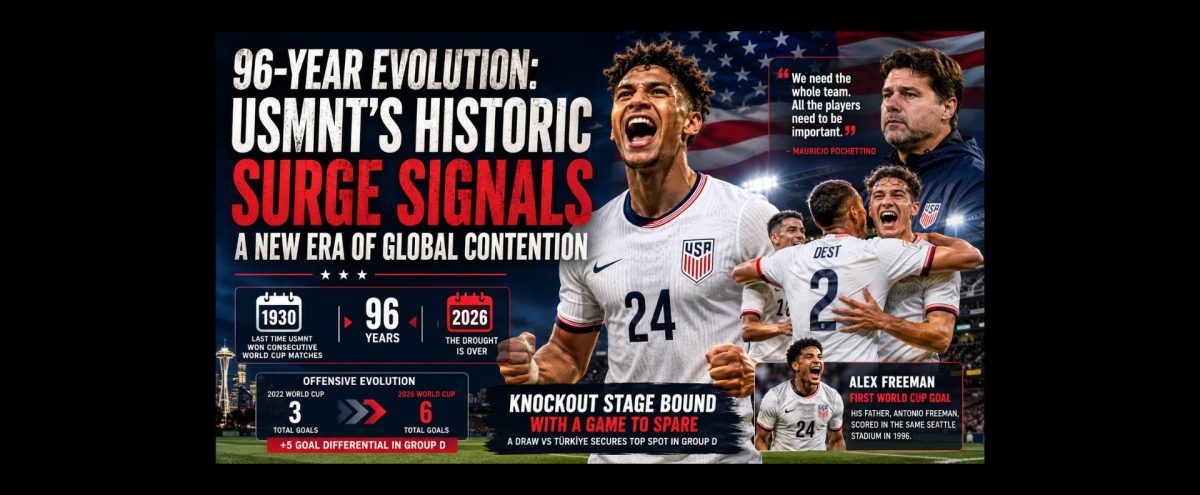
With a convincing 2-0 victory over Australia following an opening win against Paraguay, the United States achieved something it had not done since the inaugural World Cup in 1930: win consecutive matches in the tournament. The accomplishment is more than a historical footnote. It represents a turning point in the evolution of American soccer and suggests the USMNT may finally be ready to move from participant to contender.
A 96-Year Drought Finally Ends
History has often been a burden for American soccer.
While other nations built decades of World Cup traditions, the United States struggled to establish itself as a consistent force. The team occasionally produced memorable moments, but sustained success remained elusive.
That is why the victory over Australia felt so significant.
By securing six points from their first two matches, the Americans erased a statistic that had lingered for nearly a century. The last time the United States won consecutive World Cup matches was during the tournament’s inaugural edition in 1930.
That achievement alone would have been notable.
Instead, the manner in which the team accomplished it may be even more important.
The Americans did not merely survive. They controlled matches, created chances, scored goals, and displayed a level of confidence that has often been missing from previous generations.
This is the type of consistency associated with teams that make deep tournament runs.
The Death of the Negative Narrative
Before the tournament began, many analysts questioned the offensive capabilities of the USMNT.
The criticism was understandable.
During the 2022 World Cup, the United States managed only three goals during its entire tournament run. The attack often struggled to convert possession into meaningful scoring opportunities.
That offensive frustration became one of the defining storylines surrounding the program.
Two games into the 2026 World Cup, that narrative has completely collapsed.
The Americans have already scored six goals—double their entire output from the previous tournament.
Even more impressive is the efficiency.
Rather than relying on isolated moments of brilliance, the team has consistently generated dangerous attacks through organized pressing, quick transitions, and intelligent movement.
The transformation has changed how opponents view the United States and how supporters view their own team.
For the first time, fans are discussing potential knockout-round success instead of merely hoping to advance.
No Pulisic? No Problem
Perhaps the most encouraging development from the Australia match was who was not on the field.
Christian Pulisic remains the face of American soccer and arguably the most talented player the nation has ever produced. When news broke that he would miss the match due to a calf injury, concerns immediately surfaced.
Could the United States maintain its attacking momentum without its biggest star?
The answer was emphatic.
Yes.
Head coach Mauricio Pochettino resisted the temptation to make a direct replacement. Instead of inserting another winger, he adjusted the tactical structure and started Ricardo Pepi.
The move proved brilliant.
Pepi’s energy and relentless pressing disrupted Australia’s attempts to build from the back. His work rate created opportunities for teammates and helped establish the aggressive tempo that defined the match.
The performance demonstrated something every championship-caliber team possesses: depth.
Great teams are not dependent on one player.
They are built around systems, adaptability, and collective belief.
The United States showed all three.
Mauricio Pochettino’s Growing Influence
When Pochettino accepted the challenge of leading the USMNT, expectations immediately increased.
The Argentine manager arrived with experience at some of the biggest clubs in world football. His reputation for developing talent and implementing high-intensity systems made him an ideal fit for a young American squad.
Against Australia, his fingerprints were everywhere.
The tactical flexibility displayed by the Americans reflected a coach willing to adapt rather than force predetermined solutions.
Pochettino emphasized after the match that tournaments are won by entire squads, not individual stars.
That mindset appears to be spreading throughout the locker room.
Players understand their roles. Substitutes contribute when called upon. The team remains organized regardless of personnel changes.
Those characteristics are often what separate contenders from pretenders.
Alex Freeman Delivers a Storybook Moment
Every great World Cup run needs unforgettable moments.
Alex Freeman provided one against Australia.
The 21-year-old defender reacted quickly after a Sergiño Dest shot created chaos in front of goal. Freeman nodded home the rebound for his first World Cup goal, sending the Seattle crowd into a frenzy.
For a brief moment, celebration turned into anxiety.
VAR reviewed the play for a potential offside violation.
When the goal was ultimately confirmed, the eruption inside Lumen Field became one of the tournament’s defining scenes.
Yet the story extended beyond the score sheet.
Freeman’s father, Antonio Freeman, scored in the same stadium nearly three decades earlier while playing for the Green Bay Packers.
The connection created one of those uniquely American sports moments that transcend a single game.
It linked generations, sports, and family history in a way that resonated far beyond soccer circles.
Defense Continues to Be a Strength
While much of the attention has focused on the attack, the defensive performance deserves equal recognition.
Chris Richards and Alex Freeman helped anchor another clean sheet, limiting Australia’s opportunities and maintaining control throughout the match.
Successful World Cup teams are rarely one-dimensional.
They score goals, but they also prevent them.
The United States currently appears capable of doing both.
The balance between attack and defense has been one of the most encouraging developments of the tournament.
Opponents are discovering that breaking down the American defense is just as difficult as stopping its attack.
That combination is dangerous.
The Numbers Tell the Story
Statistics do not always capture the full picture.
In this case, they reinforce it.
Consider the contrast between 2022 and 2026:
2022 World Cup
- 3 total goals scored
- Limited offensive production
- Conservative approach
- Struggled to create chances
2026 World Cup (First Two Matches)
- 6 total goals scored
- +5 goal differential
- Multiple goal scorers
- Consistent attacking pressure
The difference is striking.
This is not simply a team experiencing a brief hot streak.
The numbers suggest a structural evolution.
The United States has become more aggressive, more confident, and more efficient.
That transformation is exactly what supporters hoped to see heading into a home World Cup.
The Power of Playing at Home
Host nations often enjoy advantages that statistics cannot fully measure.
Crowd support matters.
Energy matters.
Momentum matters.
Lumen Field provided all three.
More than 66,000 supporters created an atmosphere that rivaled some of the most passionate soccer venues in the world. Hours before kickoff, Seattle’s streets echoed with chants and anticipation.
Inside the stadium, every tackle, save, and scoring chance generated a thunderous response.
Pochettino even compared the atmosphere to what he has experienced with Argentina’s famously passionate supporters.
That is significant praise from someone who understands football culture at its highest level.
As the tournament progresses, home support could become one of America’s most valuable assets.
Knockout Stage Bound
Perhaps the most remarkable achievement is how quickly the United States secured advancement.
For the first time in its history, the USMNT has clinched a knockout-round berth with a group-stage match still remaining.
That changes everything.
Instead of fighting for survival, the Americans can focus on positioning and preparation.
A positive result against Türkiye would secure first place in Group D and potentially create a more favorable path through the elimination rounds.
Those opportunities matter.
Tournament success often depends on momentum and matchups.
The United States now controls much of its own destiny.
Is It Time to Dream Bigger?
For years, discussions about the United States winning a World Cup felt more like fantasy than reality.
The gap between the traditional powers and the Americans appeared too large.
That gap may finally be shrinking.
No one is suggesting the United States should suddenly become the tournament favorite. Traditional powers such as Argentina, Brazil, France, Germany, and Spain remain formidable obstacles.
However, something has changed.
The conversation itself has changed.
Defender Chris Richards captured the mood perfectly when he suggested that the idea of the United States winning the World Cup is no longer ridiculous.
That statement would have sounded outrageous in previous generations.
Today, it feels surprisingly reasonable.
Conclusion: A New Chapter for American Soccer
The 2026 World Cup is still young, and far more difficult challenges lie ahead.
Yet through two matches, the USMNT has already accomplished something historic.
The team has shattered a 96-year-old drought, silenced critics who questioned its attack, demonstrated depth without Christian Pulisic, and secured a place in the knockout rounds with confidence and authority.
Most importantly, the Americans have changed perceptions.
They are no longer simply happy to be part of the tournament.
They expect to compete.
They expect to win.
And for the first time in modern World Cup history, the rest of the world may need to start taking those expectations seriously.
The 96-year wait is over.
The era of American contention may just be beginning.