
For decades, professional networking followed a familiar formula.
Meet for coffee. Attend a chamber event. Exchange business cards. Make small talk at conferences. Repeat.
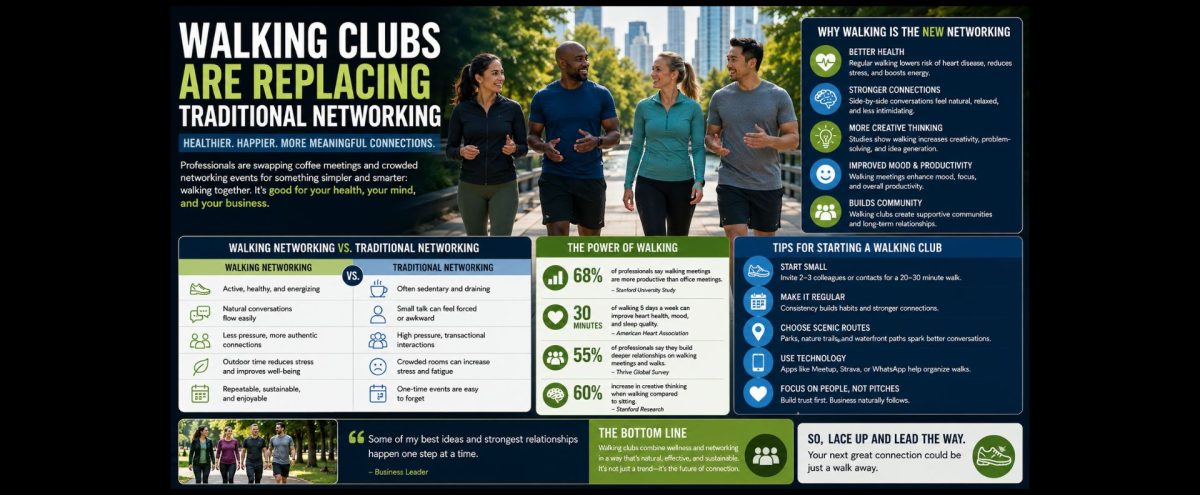
While those methods still exist, a growing number of professionals are choosing a different approach. Across the United States, walking clubs, walking meetings, and “walk-and-talk” networking groups are emerging as a preferred way to build business relationships.
The trend reflects a larger shift in workplace culture. Professionals increasingly want networking opportunities that feel authentic, healthy, and productive rather than forced and transactional.
As a result, the traditional networking breakfast is facing competition from something much simpler:
A walk.
Why Walking Is Becoming a Networking Tool
The appeal starts with a basic reality.
Most professionals spend too much time sitting.
Office workers often spend the majority of their day at desks, in conference rooms, or behind computer screens. Health experts have repeatedly warned about the risks associated with prolonged sedentary behavior. Walking offers an easy solution that can be integrated into daily routines.
At the same time, walking naturally creates opportunities for conversation.
Unlike formal networking events where attendees often feel pressured to make quick impressions, walking encourages relaxed discussions and genuine connection.
Many professionals report that conversations flow more naturally while walking side-by-side than when sitting across a table.
That dynamic is helping fuel the growth of walking-based networking groups.
The Science Behind Walking and Better Conversations
Research suggests there may be a scientific reason why walking improves interactions.
A review published in the Journal of Urban Design and Mental Health found that walking meetings can promote socialization, improve psychological well-being, and support creative thinking. Researchers concluded that walking meetings offer both health and communication benefits.
Additional research from Stanford University found that walking can significantly increase creative thinking compared to sitting. Several studies have linked walking with improved collaboration, idea generation, and problem-solving abilities.
In simple terms, movement appears to help people think differently.
For professionals looking to build relationships, brainstorm ideas, or discuss business challenges, that can be a powerful advantage.
Walking Meetings Are Leading the Way
One of the biggest drivers of this trend is the rise of walking meetings.
Instead of gathering around a conference table, colleagues walk together while discussing projects, goals, and challenges.
The concept is not new.
Steve Jobs was known for conducting walking meetings throughout his career. Today, organizations of all sizes are adopting similar practices.
A University of Miami study examined the impact of weekly walking meetings among white-collar workers. Researchers found that participants increased their physical activity levels and viewed the walking meeting format as both feasible and acceptable.
The study suggests that replacing even one seated meeting per week with a walking meeting can have measurable benefits.
As more professionals experience those benefits firsthand, the idea is spreading beyond offices and into broader networking communities.
Networking Feels More Authentic on a Walk
Traditional networking events often come with a reputation.
Many professionals describe them as awkward, scripted, and exhausting.
Walking changes the dynamic.
Instead of standing in crowded rooms making small talk, participants focus on a shared activity. The walk itself provides structure while reducing social pressure.
Experts note that side-by-side conversation often feels less confrontational than face-to-face interaction. This can encourage more open communication and more meaningful discussions.
As a result, many participants report forming stronger professional relationships through walking groups than through conventional networking events.
The focus shifts from collecting contacts to building genuine connections.
The Health Benefits Are Impossible to Ignore
One reason walking clubs are growing so quickly is that they combine networking with wellness.
Walking is one of the most accessible forms of exercise available.
According to the Mayo Clinic, regular brisk walking can improve heart health, strengthen muscles and bones, improve mood, reduce stress, enhance sleep quality, and help maintain a healthy weight.
Other health organizations report that walking can reduce the risk of cardiovascular disease, type 2 diabetes, high blood pressure, and certain cancers.
For busy professionals struggling to balance work and health, walking clubs offer a rare opportunity to accomplish both goals simultaneously.
Instead of choosing between networking and exercise, participants get both.
Walking Clubs Are Building Community
Beyond business relationships, walking groups are helping address another modern challenge: loneliness.
Many professionals work remotely or spend much of their day interacting through screens.
Walking clubs create opportunities for face-to-face interaction in a low-pressure environment.
Research has shown that walking with others can increase social engagement and strengthen community connections. Social walking traditions have existed around the world for generations because they naturally encourage conversation and relationship building.
This sense of community is becoming increasingly valuable in an era where many people report feeling disconnected despite being digitally connected.
Walking groups help fill that gap.
Why Younger Professionals Love the Trend
Millennials and Generation Z appear particularly drawn to walking-based networking.
These generations tend to place a higher value on experiences, wellness, and authenticity than previous generations.
Many younger professionals are less interested in traditional networking events that feel transactional.
Instead, they prefer activities that combine personal development, social interaction, and health.
Walking clubs fit perfectly into that mindset.
They offer a chance to meet people, exchange ideas, improve health, and spend time outdoors—all without the formal atmosphere of traditional business networking.
The result is a format that feels more modern and more appealing to emerging professionals.
Companies Are Embracing the Movement
Employers are also recognizing the value of walking initiatives.
Corporate wellness programs increasingly encourage walking meetings, lunchtime walking groups, and step challenges.
Research indicates that walking meetings may improve employee mood, productivity, and overall workplace wellness. Some studies suggest participants report higher satisfaction and stronger collaboration after incorporating walking into their work routines.
In an era where employee well-being is becoming a competitive advantage, walking programs represent a relatively inexpensive way to improve workplace culture.
That makes them attractive to employers and employees alike.
Technology Is Helping Walking Clubs Grow
Ironically, technology is helping fuel a movement that encourages people to step away from their screens.
Apps like Meetup, Strava, AllTrails, and LinkedIn groups allow professionals to organize walking events, share routes, and coordinate gatherings.
Even remote professionals are participating.
New technologies are exploring ways to support virtual walk-and-talk experiences where participants walk in different locations while maintaining conversation through wearable devices and mobile platforms.
As these tools continue to evolve, walking-based networking may become even more accessible.
The Future of Networking May Be Simpler Than We Thought
The popularity of walking clubs reflects a broader cultural shift.
People are increasingly seeking activities that combine multiple benefits rather than serving a single purpose.
Walking offers physical activity.
It supports mental health.
It encourages creativity.
It strengthens relationships.
And now, it is becoming a powerful networking tool.
Rather than gathering around conference tables or exchanging business cards at crowded events, professionals are discovering that some of their most valuable conversations happen while moving forward together—literally.
Final Thoughts
Walking clubs are not replacing every networking event.
There will always be conferences, business lunches, and industry gatherings.
But the rapid growth of walking-based networking reveals something important about today’s professionals.
People want healthier ways to connect.
They want authentic conversations.
They want meaningful relationships instead of superficial exchanges.
Walking clubs deliver all three.
In a world filled with digital distractions, endless meetings, and constant screen time, the future of networking may not involve more technology or more complexity.
It may simply involve putting one foot in front of the other.
And taking a walk.